
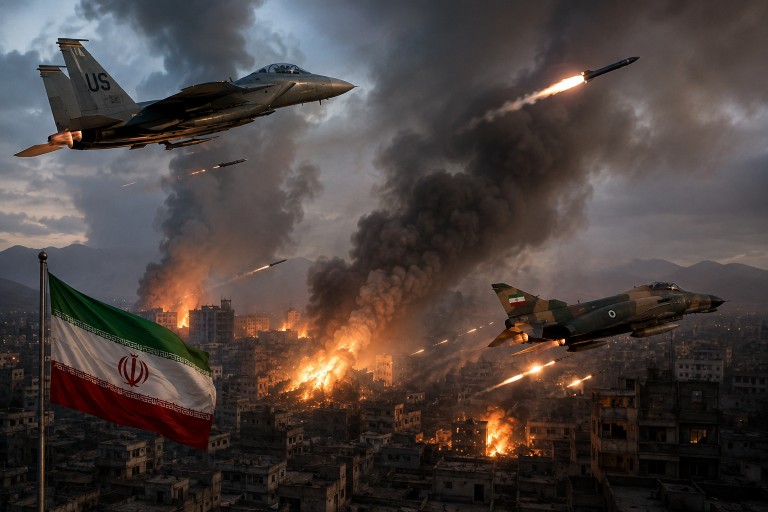
Recent exchanges of airstrikes between the United States and Iran have sparked concerns about the potential for a wider conflict in the Middle East. The US military launched strikes against targets associated with Iran’s Islamic Revolutionary Guard Corps (IRGC), citing these actions as a response to attempted assaults on commercial vessels in the Strait of Hormuz and perceived threats to American personnel.
In retaliation, Iran conducted missile and drone attacks aimed at US interests in various countries within the region, specifically targeting locations in Jordan, Bahrain, Kuwait, and Iraq. Jordan’s military reported intercepting 10 ballistic missiles that originated from Iran, while three other missiles landed in less populated areas without causing confirmed casualties or damage to a US military training facility. Additionally, Iran claimed to have attacked a US base near Erbil in Iraq, with missile and drone activities noted in Kuwait, and air-raid sirens ringing out in Bahrain.
These developments have raised alarms over the security of the Strait of Hormuz, a vital passageway for global oil transportation. In reaction to the escalation, oil prices have experienced an uptick. Furthermore, Iran has issued a warning that it might obstruct oil exports from the Gulf should Washington escalate military or economic pressure. Iranian officials have condemned the US strikes, with President Masoud Pezeshkian stating that Tehran is ready to respond if the US neglects its commitments under a previous agreement aimed at de-escalating the conflict.
The situation remains tense, with both nations cautioning that additional attacks could provoke more severe responses. US President Donald Trump has warned of a more forceful reaction should Iran proceed with further aggression. Conversely, Iranian officials have asserted that Tehran will utilize both military and diplomatic avenues to safeguard its interests. The recent hostilities mark a shift from months of indirect confrontations, which primarily involved sanctions and economic pressures, to direct military engagement, raising fears that efforts to contain the conflict might unravel, potentially leading to sustained military action in the region.