
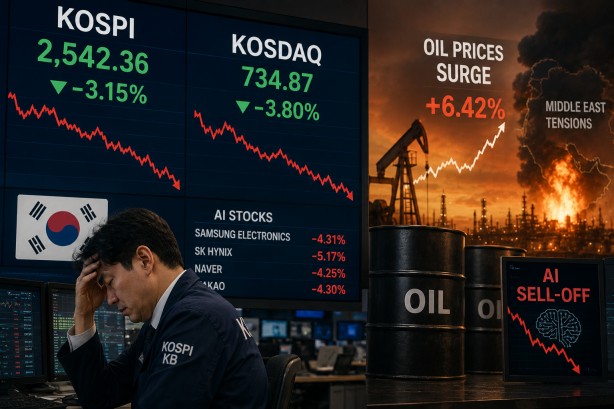
Asian markets largely trended upward on Monday, with Hong Kong’s Hang Seng index climbing 2.1% and China’s Shanghai Composite advancing 1.2%. Despite this overall positive momentum, South Korea’s Kospi index faced a significant setback, plummeting nearly 5%. This decline was driven by a sell-off in stocks related to artificial intelligence, as investors grew increasingly wary of the sector’s high valuations.
Meanwhile, oil prices saw a notable increase, with Brent crude escalating by 2.6% to reach $90.40 per barrel and U.S. crude rising 2.2% to $83.58 per barrel. The surge in oil prices was attributed to escalating tensions between the United States and Iran, stoking fears of broader disruptions in the Middle East. Concerns about global oil supplies were further heightened as tanker traffic through the Strait of Hormuz, a critical passage for energy exports, experienced a slowdown.
The Kospi’s decline was significantly influenced by losses in major technology firms, with Samsung Electronics seeing a 4.4% drop and chipmaker SK Hynix falling by 3.3%. In contrast, Taiwan’s stock market remained relatively stable, as Taiwan Semiconductor Manufacturing Co. posted a 2% gain. Additionally, Australia’s benchmark index showed a slight increase, while India’s Sensex faced a 0.9% dip.
Globally, technology stocks have been under pressure, as investors reassess the substantial investments in artificial intelligence, questioning whether a market bubble is forming. This sentiment was further impacted by the debut of Kimi K3, a new open-source AI model from Beijing-based Moonshot AI, intensifying the competitive landscape in this fast-evolving industry.
On Wall Street, last week concluded on a negative note, with the S&P 500, Dow Jones Industrial Average, and Nasdaq all recording losses. Among the hardest-hit sectors were chip stocks, with notable declines from companies such as Nvidia, Broadcom, and AMD.