
From Tregeseal stone circle, the southwestern horizon holds mysteries that transcend geography. The Isles of Scilly appear as spectral presences, their visibility fluctuating dramatically with atmospheric conditions. On clear days they manifest close and detailed; in other conditions they vanish completely. This instability may have profoundly influenced how prehistoric communities understood the western horizon and its relationship to death, renewal, and the winter solstice.
Archaeoastronomer Carolyn Kennett proposes that Tregeseal’s builders deliberately positioned the circle to frame views of these flickering islands. Ancient peoples may have interpreted their appearing and disappearing nature as evidence of liminal realms existing between physical and spiritual worlds. The winter solstice, when the sun reaches its southern extreme before reversing course, would have been an appropriate time for rituals acknowledging these threshold spaces.
Cornwall’s position at Britain’s southwestern edge reinforced associations between western horizons and otherworldly realms. Many cultures associate the setting sun with death and the underworld. The Land’s End peninsula points directly toward the winter solstice sunset, creating what Kennett describes as an entire landscape oriented toward this symbolically charged direction.
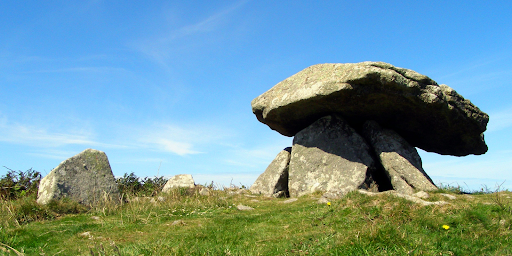
Multiple monuments demonstrate this pattern. Chûn Quoit sits positioned so winter solstice observers witness the sun setting precisely over Carn Kenidjack’s rocky profile—another marker on the western horizon. Tregeseal circle frames the Isles of Scilly. This coordinated orientation suggests shared cosmological beliefs that connected western directions with death, darkness, and the promise of eventual renewal.
The mysterious Kenidjack holed stones add complexity to this landscape. Their unique design may have created specific light effects during autumn, marking time’s passage toward the solstice. Modern Cornwall maintains these connections through festivals like Montol, where symbolic sun burning and torch-lit processions to the sea echo ancient themes. The peninsula’s combination of prehistoric monuments, folklore traditions, and living celebrations creates a uniquely powerful context for experiencing winter solstice’s astronomical, cultural, and spiritual dimensions.