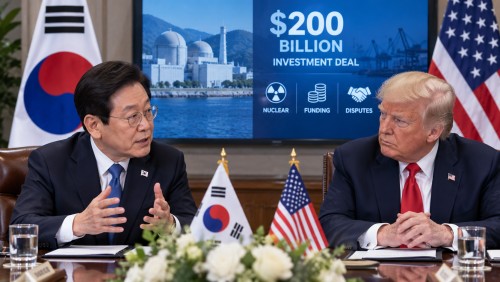
Major delays loom over South Korea’s ambitious $200 billion investment in the United States due to unresolved issues surrounding nuclear projects and financial commitments. This uncertainty could significantly impact plans to enhance nuclear collaboration between the two nations, which includes the construction of multiple reactors on US soil.
The core of the disagreement centers on nuclear reactor design choices and how South Korea’s financial contributions are timed. With discussions yet to yield a final decision, these factors continue to hinder the finalization of the agreement. South Korea’s Industry Ministry has highlighted that significant differences remain in these negotiations.
Specifically, the two countries have been considering the construction of eight nuclear reactors in the US, six of which would use Westinghouse’s AP1000 design, while two would employ South Korea’s APR1400 technology. However, US officials and Westinghouse have expressed reservations about including the APR1400 design, making it challenging to conclude the nuclear agreement.
Further complicating matters, South Korea is seeking a substantial stake in Westinghouse, aiming for a 15% to 20% ownership along with voting rights and a board seat. Westinghouse, on the other hand, reportedly wants to restrict Seoul’s stake to below 10%. Additional issues involve South Korea’s potential participation in a US project for processing spent nuclear fuel and a proposed Alaska liquefied natural gas project, where construction costs and long-term returns are still under scrutiny.
Funding schedules have also been a sticking point, with Washington requesting over $9 billion from South Korea by year’s end. Initially, Seoul planned to offer a smaller amount by 2026, escalating annual investments from 2027 onward. Disagreements persist over calculating investment returns, with South Korea advocating for profits from successful projects to offset losses from others, contrasting with the US preference for evaluating each project on its own.
Despite these challenges, both governments continue to work towards a resolution. The South Korean Industry Ministry stresses that the specifics of the projects, funding structure, and investment agreements are still under discussion, leaving the future of this significant investment partnership uncertain.