
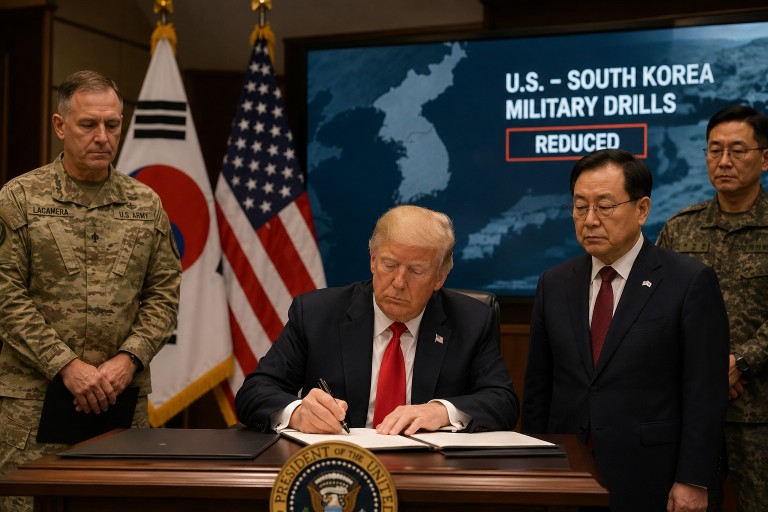
In a significant move, US President Donald Trump has mandated a considerable reduction in joint military exercises with South Korea, citing their financial burden and the signal they send to North Korea as reasons for the cutback. Trump attributed this decision to his “very good relationship” with North Korean leader Kim Jong-un. The joint drills, known as the Ulchi Freedom Shield exercises, were planned to commence on Monday and last until August 27, involving approximately 18,000 South Korean troops alongside US forces and personnel from various United Nations Command member states.
Although Trump expressed it was too late to entirely halt the exercises, he directed Defence Secretary Pete Hegseth to substantially reduce US involvement. Contrary to this, South Korea’s defence ministry announced that the drills would proceed as initially planned. This decision emerged amidst warnings from US and South Korean military officials about North Korea’s growing combat expertise due to its military cooperation with Russia in the Ukraine conflict.
North Korea has engaged over 14,000 troops in support of Russian forces, also supplying artillery ammunition and ballistic missiles. Military experts note that North Korean forces are gaining experience in modern warfare technologies, such as drones, GPS disruption, cyber operations, and missile systems. In response to these evolving threats, US military officials stated that the exercises had been adjusted accordingly. They cautioned that the skills acquired by North Korean troops in Ukraine could enhance Pyongyang’s military capabilities upon their return.
Trump’s decision to scale back the exercises has raised renewed concerns in Seoul regarding the US-South Korea alliance’s future and regional deterrence. South Korean experts have warned that reducing the exercises might weaken military preparedness and deterrence, offering limited diplomatic advantages since North Korea has historically insisted on their complete cancellation. North Korea has labeled the exercises as rehearsals for an aggressive war and has threatened to counter with stronger military measures, even test-firing ballistic missiles ahead of the drills.
Despite the US decision, South Korean officials have emphasized the importance of the joint exercises in preparing for a more capable North Korean military. Trump’s previous reductions or suspensions of major US-South Korean military exercises while engaging diplomatically with Kim Jong-un have been a contentious issue in the region. The latest move further underscores the delicate balance between seeking diplomatic progress and maintaining military vigilance.